Baja SAE
I’m currently a member of my university Baja SAE team’s electrical and software branch. Below is some documentation of my work on the car’s dashboard.
2026-2027 Season
WIP, will update as season progresses :)
2025-2026 Season
Overview
After receiving new member training, I began working on the car’s dashboard, which my friend oversaw development of the year before. My objectives for the dash this season were:
- Upgrade the tachometer and speedometer gauges to more reliable servoes that would not fail as often
- Incorporate a daylight-readable LCD for better readability and information presentation options
- Add a smaller, one-chip solution for interfacing with the car’s CAN bus.
Results
Objective 1 was fairly straightforward, as I swapped the dash’s gauge servoes from small generic blue hobby servoes to goBILDA’s proton servoes, which are larger and metal geared. If anything, these are comically over spec, and will likely be the last things to fail on the dash (they haven’t failed yet).
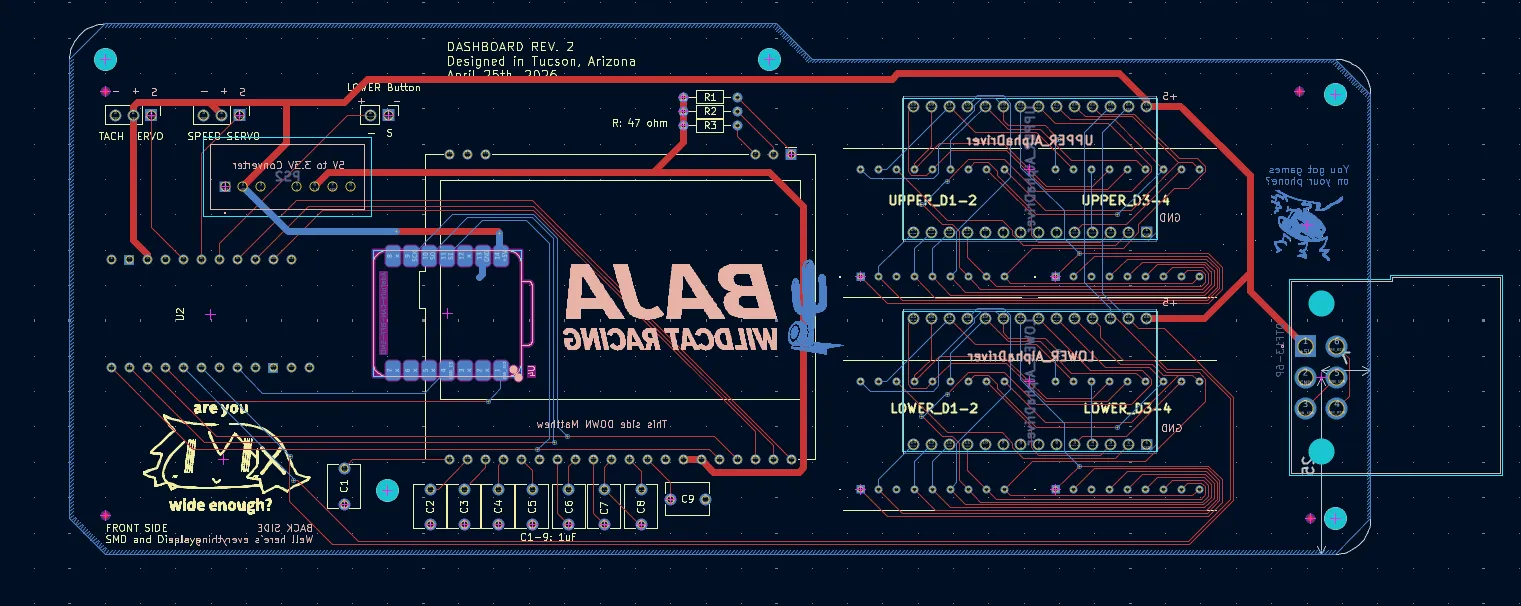
Objective 2 proved to be more difficult than expected. My design requirements for an LCD display lead me to the Display Visions DOGM128W, a transflective, Arduino-compatible display which could be read in direct sunlight. An initial test of this display is shown below:
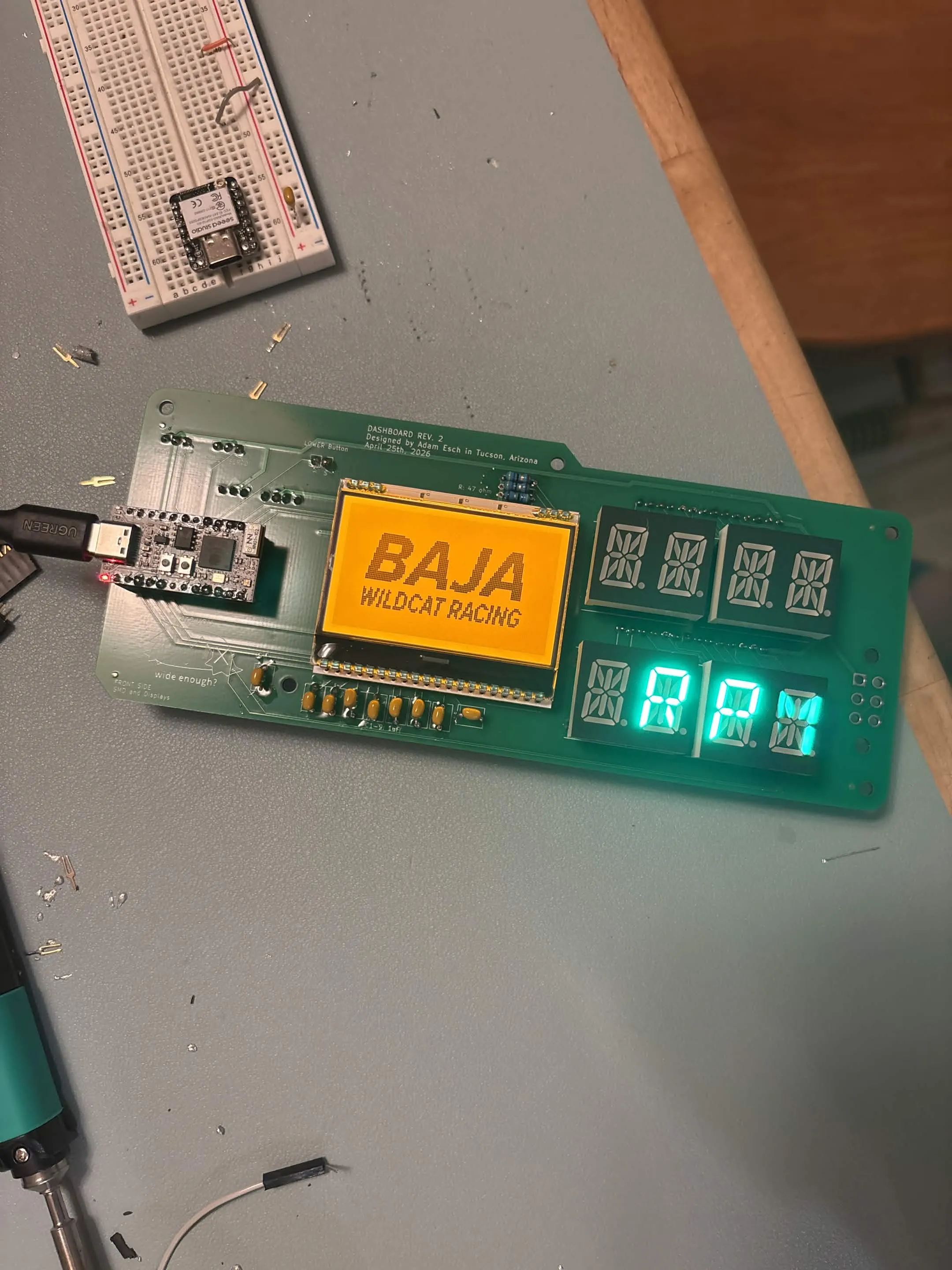
I had assumed that “Arduino-compatible” meant I could simply insert it into my design and that it would work out of the box (like most of the other modules present on the dash), however even after having Claude assist me in modernizing the library, I had continued issues with its library disrupting SPI bus initialization. This meant that I could only get the CAN bus chip OR LCD working, not both at once. For the sake of usability, I disabled the LCD pre-competition to preserve CAN bus functionality.
For Objective 3, I initially wanted to directly integrate the CAN chip and supporting circuitry onto the dashboard PCB itself, thus reducing the number of external boards needed. However, a combination of time constraints, difficulty sourcing and then placing the small SMD components onto the board meant that I had to rely on an external PCB with the same chip to implement CAN-bus functionality. After tweaking the underlying CAN library shared across all microcontrollers on the car, the dash was able to communicate and receive data from the rest of the car, a mere week before the car was driven out to competition.